
Choosing
White, grey or black: choosing a standing desk finish

Written by Giedrius Zdramys, Director, Gieto Group Ltd (Desko)
Updated 9 September 2026
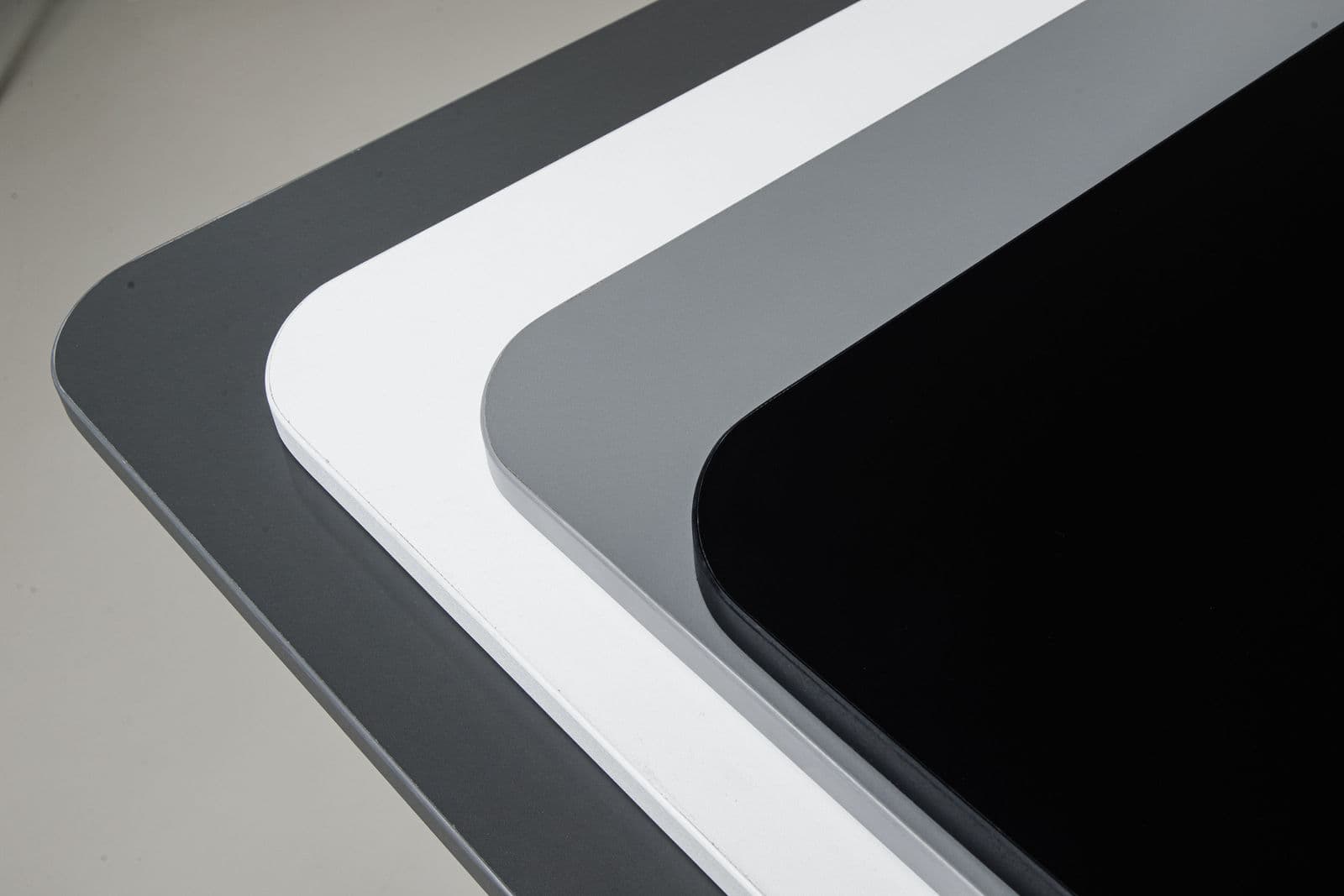
The finish is the one decision that has nothing to do with engineering, and the one you look at every day.
All three of ours are the same FSC-certified laminate with rounded corners — the difference is entirely how they behave in a room.
Short answer
White lifts small or dark rooms but shows dust and cable shadows. Grey is the most forgiving day to day and hides marks best. Black looks the most deliberate and anchors a screen-heavy setup, but shows dust more than grey. All three are the same laminate.
White
White reflects light, so it makes a small or north-facing room feel bigger and brighter. It suits pale walls and wooden floors, and it stops a desk with three screens on it from feeling like a control room.
The trade-off is that it shows everything: dust, crumbs, the shadow of cables underneath, and the ring from a mug. If your desk lives in a bright room and you wipe it down regularly, that is fine.
Grey
Grey is the least demanding finish. It hides dust and fingerprints better than either extreme, sits comfortably against almost any wall colour, and does not fight with the equipment on it.
If you cannot decide, or the desk is going into a shared or busy space, this is the safe answer — which is why it is the finish we picture most often.
Black
Black makes the desk recede and everything on it stand out. It suits darker rooms, gaming setups and anywhere you want the screens to be the focus.
It shows dust more than grey and can make a small room feel smaller. Paired with a black frame it reads as one solid object; paired with a white frame it looks lighter and more graphic.
Mixing the top and the frame
The top and the frame are chosen separately, so you are not limited to matching pairs. A black top on a white frame is one of the most popular combinations we photograph — it keeps the desk visually light while hiding marks on the surface you actually touch.
Matching top and frame reads as a single, quieter object. Contrasting them makes the frame part of the design. Neither is wrong; the builder shows a real photograph of every combination so you can see it rather than imagine it.
What the finish does not change
Durability, thickness, edge profile and the cable ports are identical across all three. So is the price. Choose on how it looks in your room and how much cleaning you are prepared to do.
How the finish behaves under a screen
Most desks spend their life under a bright monitor, and that changes how a finish reads. White bounces screen light back up at your face, which can add to glare in a dark room. Black absorbs it and makes the screen feel like the only lit object, which some people find restful and others find gloomy.
Grey sits between the two and is the most neutral under both daylight and lamp light. If your room is north-facing or you work in the evening, that neutrality is worth more than the aesthetics.
Matching the frame to the room
A useful rule: match the frame to the largest nearby object, not to the desktop. A white frame against a white wall disappears and makes the desk look like it is floating. A black frame in front of a dark bookcase does the same.
If you want the desk to be furniture rather than equipment, match top and frame. If you want the room to read as lighter, put a dark top on a light frame — the mass sits at eye level and the legs recede.
Living with each finish
Scroll the table →
| Finish | Shows dust | Shows marks | Best in |
|---|---|---|---|
| White | Some | Most | Small or dark rooms, pale interiors |
| Grey | Least | Least | Anywhere — the safe default |
| Black | Most | Some | Bright rooms, screen-led setups |
All three are the same FSC-certified laminate: wipe-clean, rounded corners, cable ports both sides, same price.
Does the finish affect resale or longevity?
Not meaningfully. All three use the same board and the same edge treatment, so they wear at the same rate. What differs is how visible that wear is: a scuff on black shows as a lighter mark, on white as a darker one, and on grey barely at all.
If the desk is likely to move house, be handed to a family member or be resold, grey and white are the easier sells because they suit more rooms. Black is the most specific choice and the one people either want or do not.
Choosing when you cannot see it in person
Screens lie about colour, so use references you already own. Our grey sits close to a standard light-grey office finish; the white is a soft warm white rather than a bright paper white; the black is a true neutral black with no blue or brown cast.
Two practical tests before you order: hold a sheet of printer paper against your wall — if the wall looks yellow next to it, a warm white top will blend rather than clash. And look at your monitor's own casing, since it will sit on the desk all day. Matching the desk to the screen is a surprisingly reliable shortcut.
Questions, answered.
Which colour shows dust the least?+
Grey, comfortably. Black shows dust most, white shows crumbs and marks most.
Can I have a different top and frame colour?+
Yes. Every top and frame combination is available and photographed, so you can see the exact pairing before buying.
Is the laminate the same on all three?+
Identical — the same FSC-certified board, thickness, rounded corners and cable ports. Only the colour differs.
Written by Giedrius Zdramys, Director, Gieto Group Ltd (Desko)
Updated 9 September 2026
Read next
Ready to choose?
Three frames, three sizes, three finishes.